


The Builder’s Blueprint: Building a Movement Ministry That Lasts.

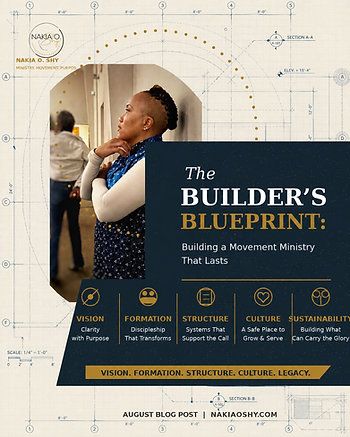
Vision, formation, and structure for ministers of movement
There is a kind of excitement that comes when God gives vision.
You can feel it before you can fully explain it. A picture begins forming in your spirit. You start seeing people gathered, garments flowing, worship rising, dancers growing, ministry moving with purpose. There is fire in it.
And then reality knocks on the door like it pays rent.
Who is going to lead rehearsal?
Where will we meet?
What is the standard?
Who is ready to minister publicly?
How do we handle correction?
How do we care for people spiritually and not just use their gifts?
Vision is beautiful.
Building requires something else.
Many ministers of movement love the moment of ministry but feel less prepared for the work of building ministry. And honestly, that makes sense. We often inherit passion before we inherit structure. We know how to worship, but no one always teaches us how to form a team, disciple dancers, communicate expectations, protect the assignment, and create a culture that can survive beyond one powerful service.
But if a ministry is going to last, it needs more than inspiration.
It needs a blueprint.
Vision Is the Beginning, Not the Building
Vision matters deeply.
Without vision, ministry becomes activity. People gather, songs are chosen, movement is created, but no one is really sure where it is all going.
A clear vision helps answer the deeper questions:
Why do we exist?
Who are we called to serve?
What is God asking us to cultivate?
What kind of people should this ministry be forming?
Those questions matter because dance ministry is not simply about creating presentations. It is about forming ministers.
That is where we sometimes have to slow down.
It is tempting to begin with the visible pieces: garments, choreography, events, and invitations. Those things are not wrong. They may even be necessary. But they are not the foundation.
The foundation is identity.
A movement ministry must know who it is before it can decide what it does.
Are we a worship ministry?
An outreach ministry?
A prophetic movement team?
A training and discipleship space?
A community for healing and restoration?
Some combination of these?
Clarity does not limit God. It gives the people entrusted to you a place to stand.
A Ministry Culture Is Built Before It Is Announced
Every ministry has a culture.
Some are intentional. Some are accidental.
Culture is what people feel when they enter the room. It is how correction is given. It is how conflict is handled. It is whether prayer is central or decorative. It is whether dancers feel discipled or merely scheduled.
Culture shows up in the small things.
Do people arrive prepared?
Do leaders communicate clearly?
Are rehearsals spiritually grounded or simply task-driven?
Is there space for growth without shame?
Are expectations spoken, or does everyone have to guess and then get corrected for guessing wrong?
That last one will wear a team out quickly. Guesswork is not leadership. It is spiritual charades with worse lighting.
If we want healthy ministries, we have to build healthy cultures on purpose.
That means naming values before problems arise.
For a movement ministry, those values may include:
Prayer before presentation
Formation before platform
Excellence without perfectionism
Accountability with grace
Unity without uniformity
Spiritual maturity alongside artistic growth
A ministry that lasts cannot be built on talent alone. Talent may gather people, but culture keeps them healthy.
Discipleship Must Be Part of the Blueprint
A movement ministry is not just a group of people who dance together.
At its best, it is a discipleship environment.
This means leaders must ask more than "Can this person move well?"
We also have to ask:
Are they growing spiritually?
Are they teachable?
Can they receive correction?
Do they understand worship as service?
Are they learning to hear God beyond the music?
These questions are not meant to create barriers. They create care.
When dancers are only valued for what they can do publicly, ministry becomes transactional. People serve, but they are not shepherded. They pour, but no one checks whether they are empty.
Discipleship changes that. It says, “Your gift matters, but your soul matters more.”
That may look like monthly devotionals, prayer partners, scripture study, leadership development, mentorship, or intentional conversations after rehearsal. It does not have to be complicated. It does have to be consistent.
The goal is not to produce performers who know church language.
The goal is to cultivate worshipers whose lives can carry what their bodies express.
Structure Is Not the Enemy of the Spirit
Some people hear the word structure and immediately get nervous.
They imagine rigid rules, cold systems, and all the life being squeezed out of the room. Fair. We have all seen structure used poorly. Structure without Spirit becomes control.
But Spirit without structure can become confusion.
A healthy blueprint does not restrict the move of God. It supports the people called to steward it.
Structure helps answer practical questions before emotions are high:
How often do we rehearse?
What is required for participation?
How are ministry assignments selected?
What happens when someone misses rehearsal?
How do we prepare spiritually before ministering?
Who makes final decisions?
How do we handle garments, music, and communication?
These are not small things. They shape trust. When expectations are clear, people can serve with more peace. When standards are consistent, leaders do not have to keep reinventing the wheel every week, as if ministry were some sacred game show.
Structure gives the ministry rhythm. And rhythm matters to dancers.
Not Every Gift Is Ready for Every Platform
This is one of the harder truths in ministry leadership.
A person can be gifted and still be in formation. A dancer may have ability but need time to mature in character, consistency, or spiritual understanding. That does not mean they are rejected. It means they are being developed. In healthy ministry, “not yet” should never sound like “not wanted.”
Leaders need wisdom here. We cannot be so protective of the platform that we crush emerging ministers. But we also cannot be so eager to include everyone that we place people in assignments before they are prepared to carry them.
There is a tension.
We want to make room. We also want to steward the altar. That requires discernment, patience, and honest communication. A strong blueprint creates pathways for growth. Not everyone may minister publicly at the same time, but everyone should have a way to develop. Workshops, training sessions, private worship opportunities, observation, mentorship, and smaller assignments can all become part of the process.
The platform is not the only place formation happens. Sometimes it is not even the best place.
Leadership Requires Both Vision and Care
Building a movement ministry requires more than a creative eye.
It requires pastoral sensitivity.
Leaders of movement ministries often carry multiple responsibilities at once. They are choreographers, teachers, intercessors, administrators, encouragers, correction-givers, garment coordinators, calendar keepers, and occasional emergency hem fixers. Glamorous? No. Holy? Often.
But beneath all of that is care.
People are not props for vision.
They are vessels.
A leader must be willing to ask: Am I building people, or am I simply building a ministry through people?
That question will check the heart quickly.
A lasting ministry is not measured only by how powerful the presentation was. It is also measured by whether people are growing, healing, serving with joy, and becoming more rooted in God.
If the ministry looks excellent publicly but leaves people wounded privately, something in the blueprint needs attention.
Questions for the Builder
Before rushing into the next season, take time to sit with the blueprint.
What are we actually building?
Not what sounds good on paper. Not what looks impressive online. What has God truly assigned this ministry to become?
A ministry without clarity will chase every opportunity and eventually call exhaustion obedience.
Who are we becoming while we build?
The process matters. If building the ministry makes us more controlling, more anxious, more competitive, or more disconnected from prayer, then the structure may be growing faster than the soul of the ministry.
God is not only interested in what we produce. He is forming who we are becoming.
Where do we need more structure?
Sometimes frustration reveals the absence of a system.
If the same confusion keeps happening, it may not be a people problem. It may be a clarity problem.
Where do we need more grace?
Structure matters, but people are still human. A ministry that lasts needs standards and compassion. Too much looseness creates disorder. Too much rigidity creates fear.
Wisdom knows how to hold both.
Are we discipling dancers or only scheduling them?
This one deserves a pause.
Because a full calendar can hide an empty formation process.
A Prayer for Movement Ministry Builders
Father,
Thank You for the vision You have entrusted to us.
Teach us how to build with wisdom, patience, and humility.
Help us not to rush what You are forming.
Give us clarity where there has been confusion, structure where there has been disorder, and grace where people are still growing.
Teach us to honor both the gift and the vessel.
Let our ministries be places of prayer, discipleship, excellence, and healing.
Protect us from building platforms without forming people.
May every rehearsal, every meeting, every correction, every offering, and every act of service point back to You.
Build us as we build for You.
Amen.
Building What Can Carry the Glory
A lasting movement ministry is not built by accident.
It is prayed through. Talked through.Corrected.Adjusted.Strengthened.Sometimes rebuilt.
And that is not failure. That is stewardship.
The builder’s blueprint is not about making ministry stiff or overly formal. It is about creating something strong enough to carry what God wants to pour into it.
Vision gives us direction.
Formation gives us depth.
Structure gives us sustainability.
And the Spirit gives life to it all.
So build slowly if needed. Build prayerfully. Build with people in mind, not just presentations.
Because the goal is not simply to have dancers on the floor.
The goal is to raise ministers who can carry worship with wisdom, humility, and holy fire.


Comments